What is TB-500? Thymosin beta-4 fragment, research and legal status
What is TB-500? A synthetic fragment of thymosin beta-4 (Ac-LKKTETQ). This guide explains its origin, the research on thymosin beta-4, the difference to thymosin alpha-1 and the legal status in Europe.
 What is TB-500
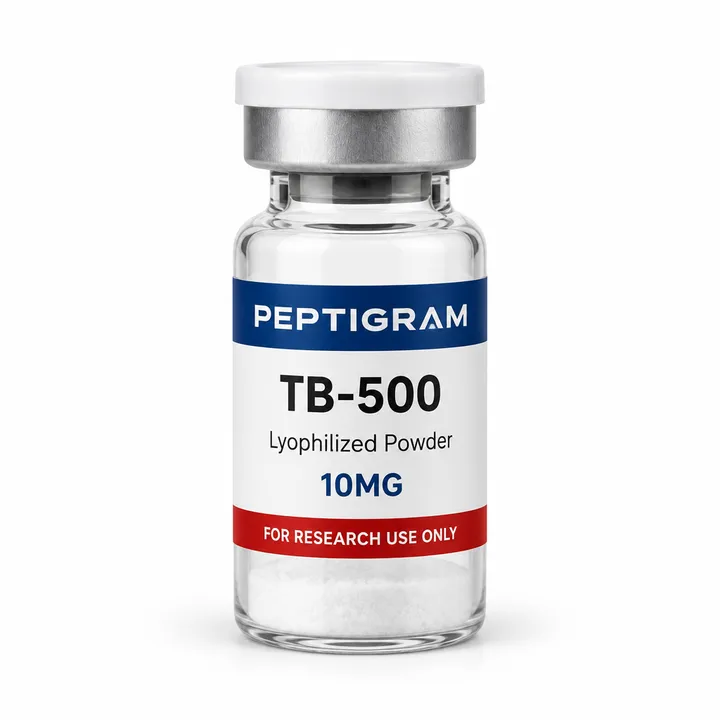
TB-500 is a synthetic peptide that copies the actin-binding region of thymosin beta-4, a small protein that is present in almost every human cell. In research catalogues the name usually refers to the seven amino acid sequence Ac-LKKTETQ. Laboratories use TB-500 to study how cells move, how new blood vessels form and how tissue closes after an injury in cell and animal models. TB-500 is not an approved medicine in any EU country, and it is sold for laboratory research only.
This guide explains where TB-500 comes from, how it differs from the full thymosin beta-4 protein, what the published studies show and how it is regulated in Europe. It also explains why TB-500 is often confused with thymosin alpha-1, a different peptide with a similar name.
What is TB-500? From thymosin beta-4 to a short fragment
Thymosin beta-4 (Tβ4) is a protein of 43 amino acids. Low, Hu and Goldstein published its complete sequence in 1981, after the protein had been isolated from calf thymus tissue. The name "thymosin" comes from this origin. Later work showed that thymosin beta-4 is not specific to the thymus. It is found in nearly all cell types and is especially abundant in blood platelets and white blood cells.
In 1991, Safer and colleagues showed that thymosin beta-4 is the main protein that binds free actin monomers (G-actin) inside cells. Actin is the building block of the cell skeleton. When a cell moves, it assembles and disassembles actin filaments at its front edge. By holding a reserve of actin monomers, thymosin beta-4 controls how quickly these filaments can grow.
The region that binds actin sits between amino acids 17 and 23 of thymosin beta-4. Its sequence is LKKTETQ. TB-500 is a synthetic copy of this region with an acetyl group on the first amino acid:
Sequence: Ac-Leu-Lys-Lys-Thr-Glu-Thr-Gln (Ac-LKKTETQ)
Parent protein: thymosin beta-4, residues 17 to 23
Molecular weight: about 889 Da (the full thymosin beta-4 protein has about 4,960 Da)
Form in research catalogues: lyophilised powder in a sealed vial
The name TB-500 is a trade name, not a scientific standard. Some suppliers use it for the short fragment and others for the full 43 amino acid protein. For any study it is therefore important to check the sequence and the molecular mass on the certificate of analysis.
TB-500 vs thymosin beta-4: what the fragment keeps and what it loses
A short fragment is easier and cheaper to synthesise than a protein of 43 amino acids. It also has fewer positions where the synthesis can fail, which makes purity easier to control. The question for research is how much of the biology of thymosin beta-4 the fragment keeps.
| Feature | TB-500 (Ac-LKKTETQ) | Thymosin beta-4 (full protein) |
|---|---|---|
| Length | 7 amino acids | 43 amino acids |
| Molecular weight | about 889 Da | about 4,960 Da |
| Actin binding | Contains the central actin-binding motif | Complete actin-binding domain |
| Other active regions | Not included | Includes the N-terminal Ac-SDKP sequence |
| Amount of published data | Limited, mostly cell and animal models | Large: cell, animal and early clinical studies |
The second active region of thymosin beta-4 is its N-terminal end. The first four amino acids, Ac-SDKP, are released when the protein is cut by enzymes. Ac-SDKP has been studied on its own, mainly in models of fibrosis and inflammation. TB-500 does not contain this sequence. Results from studies with the full protein can therefore not be transferred to the fragment without testing.
TB-500 research: what the thymosin beta-4 studies show
Most published work uses the full thymosin beta-4 protein. The main research areas are:
Wound closure: Malinda and colleagues (1999) reported faster closure of full-thickness skin wounds in rats that received thymosin beta-4. The treated wounds showed more new blood vessels and more collagen.
Heart tissue: Bock-Marquette and colleagues (2004) showed in Nature that thymosin beta-4 activates integrin-linked kinase and improves the survival of heart muscle cells in a mouse model of myocardial infarction.
Progenitor cells and blood vessels: Smart and colleagues (2007) described how thymosin beta-4 mobilises progenitor cells in the outer layer of the adult mouse heart and supports the formation of new vessels.
Eye surface: eye drops with thymosin beta-4 (development code RGN-259) have been tested in clinical trials for dry eye and corneal defects. The results on the primary endpoints were mixed, and no product has been approved.
Goldstein, Hannappel and Kleinman summarised these findings in 2005 in a review in Trends in Molecular Medicine. They describe thymosin beta-4 as an actin-binding protein that also acts outside the cell, where it influences cell migration, survival and inflammation.
Studies that use only the TB-500 fragment are far fewer. Most of them are small cell or animal experiments. This is why many laboratories test TB-500 next to the full protein, or next to BPC-157, which acts through different pathways. Our comparison of BPC-157 vs TB-500 explains these differences in detail.
TB-500 and thymosin alpha-1: two different thymosins
The word "thymosin" describes a group of peptides that were first isolated from the same thymus extract, called thymosin fraction 5. Despite the shared name, the members of this group are not related in structure or function. TB-500 and thymosin alpha-1 are the two thymosins that appear most often in research catalogues.
TB-500 is based on thymosin beta-4. It is studied for actin binding, cell migration and tissue repair models.
Thymosin alpha-1 is a peptide of 28 amino acids. Goldstein and colleagues described its isolation and sequence in 1977. It is studied in models of the immune system, mainly the maturation and activity of T cells.
The two peptides have different sequences, different targets and different research areas. A study design should never use one as a replacement for the other. Thymosin alpha-1 is listed in our immune research peptides, while TB-500 belongs to the tissue research peptides.
Handling TB-500 in the laboratory
TB-500 is supplied as a lyophilised powder. In this dry form it is stable for long periods if it is kept cold and protected from light and moisture.
Storage of the closed vial: -20 °C for long-term storage, 2 to 8 °C for a few weeks.
Reconstitution: the short and water-soluble sequence dissolves readily in bacteriostatic water. Add the solvent slowly along the glass wall and swirl the vial instead of shaking it.
After reconstitution: keep the solution at 2 to 8 °C and label it with the date and the concentration.
Our guide on how to reconstitute peptides describes each step, and the guide on sterile technique explains how to avoid contamination of the solution.
TB-500 legal status in Europe and the WADA list
TB-500 has never been authorised as a medicine by the European Medicines Agency or by a national authority in the EU. In most EU countries it can be sold as a research chemical for laboratory use. It may not be sold as a medicine, as a food supplement or for use in humans. The details differ between countries, for example in Germany (BfArM) or in Austria (BASG). Our overview of the legal status of peptides in Europe lists the rules country by country.
In sport, the rule is clear. The WADA Prohibited List names thymosin beta-4 and its derivatives, including TB-500, in section S2. The substance is prohibited at all times, in and out of competition. Doping laboratories in human and equine sport have developed tests that detect TB-500 and its metabolites.
TB-500 FAQ
Is TB-500 the same as thymosin beta-4?
Is TB-500 legal in Germany?
Why is TB-500 often combined with BPC-157 in research?
How can a laboratory check the identity of TB-500?
Buy TB-500 for research
If your study needs TB-500, our TB-500 10 mg vial contains the Ac-LKKTETQ fragment as a lyophilised powder, with a certificate of analysis on file for documented batches. For combined models there is also the BPC-157 / TB-500 blend with both peptides in one vial.
Sources
Low TL, Hu SK, Goldstein AL (1981). Complete amino acid sequence of bovine thymosin beta 4. Proceedings of the National Academy of Sciences 78(2), 1162-1166. doi.org/10.1073/pnas.78.2.1162
Safer D, Elzinga M, Nachmias VT (1991). Thymosin beta 4 and Fx, an actin-sequestering peptide, are indistinguishable. Journal of Biological Chemistry 266(7), 4029-4032. doi.org/10.1016/S0021-9258(20)64278-8
Malinda KM, et al. (1999). Thymosin beta 4 accelerates wound healing. Journal of Investigative Dermatology 113(3), 364-368. doi.org/10.1046/j.1523-1747.1999.00708.x
Bock-Marquette I, Saxena A, White MD, et al. (2004). Thymosin beta 4 activates integrin-linked kinase and promotes cardiac cell migration, survival and cardiac repair. Nature 432, 466-472. doi.org/10.1038/nature03000
Goldstein AL, Hannappel E, Kleinman HK (2005). Thymosin beta 4: actin-sequestering protein moonlights to repair injured tissues. Trends in Molecular Medicine 11(9), 421-429. doi.org/10.1016/j.molmed.2005.07.004
Smart N, Risebro CA, Melville AAD, et al. (2007). Thymosin beta 4 induces adult epicardial progenitor mobilization and neovascularization. Nature 445, 177-182. doi.org/10.1038/nature05383
Goldstein AL, Low TL, McAdoo M, et al. (1977). Thymosin alpha 1: isolation and sequence analysis of an immunologically active thymic polypeptide. Proceedings of the National Academy of Sciences 74(2), 725-729. doi.org/10.1073/pnas.74.2.725
Sold for laboratory research only and not intended for use in humans or animals. TB-500 is not an approved medicine. This guide gives no medical advice and no instructions for human use.