MOTS-c vs SS-31 vs NAD+: mitochondrial research compounds compared
MOTS-c vs SS-31 vs NAD+: a signalling peptide, a cardiolipin-binding peptide and a coenzyme. This guide compares structure, targets, research models and research status.
 MOTS-c vs SS-31 vs NAD+
The question MOTS-c vs SS-31 vs NAD+ comes up often in mitochondrial research, yet the three compounds are not alternatives to one another. MOTS-c is a signalling peptide that the mitochondrial genome encodes. SS-31 is a synthetic peptide that binds to a lipid in the inner mitochondrial membrane. NAD+ is not a peptide at all but a coenzyme for redox reactions. This guide explains what each compound is, how they differ, which research questions fit each one and how the research status looks in October 2026.
MOTS-c vs SS-31 vs NAD+: the short answer
All three compounds belong to mitochondrial bioenergetics research, but they act at different levels of the cell:
MOTS-c works as a messenger. It is studied as a signal that links the mitochondria to the rest of the cell, including the nucleus.
SS-31 works at the membrane. It is studied as a structural protector of the inner mitochondrial membrane and the respiratory chain.
NAD+ works as a substrate. It carries electrons in metabolic reactions and is consumed by several enzyme families.
A study that asks how mitochondria send signals points towards MOTS-c. A study that asks how the inner membrane holds up under stress points towards SS-31. A study that asks how the cellular redox and NAD+ pool change points towards NAD+ or its precursors.
MOTS-c: a peptide encoded in mitochondrial DNA
MOTS-c is a peptide of 16 amino acids. Its sequence is encoded in the 12S rRNA region of mitochondrial DNA, which makes it one of the few known peptides that come from the mitochondrial genome rather than from the nucleus. Researchers call this group mitochondrial-derived peptides.
Lee and colleagues described MOTS-c in 2015 in Cell Metabolism. In cell culture and in mice, the peptide acted on metabolic regulation, and the authors linked part of this activity to the AMPK pathway, a central energy sensor of the cell. Our summary of the MOTS-c discovery study describes the design of this work.
A second study by Kim and colleagues (2018, Cell Metabolism) showed that MOTS-c can move from the cytoplasm into the nucleus when cells are under metabolic stress. In the nucleus it was associated with changes in the expression of nuclear genes. This finding made MOTS-c an example of direct communication from the mitochondria to the nucleus.
Reynolds and colleagues (2021, Nature Communications) reported that MOTS-c levels in human skeletal muscle and in plasma rose in connection with exercise. They also studied MOTS-c in mouse models of ageing. The human part of this work was observational. It measured natural MOTS-c levels and did not test MOTS-c as an administered compound in people.
SS-31: a synthetic peptide that binds cardiolipin
SS-31 is a synthetic tetrapeptide with the sequence D-Arg-Dmt-Lys-Phe-NH2. Dmt stands for 2',6'-dimethyltyrosine. The compound is also known as elamipretide, MTP-131 and Bendavia. SS-31 belongs to the aromatic-cationic peptides: it carries positive charges and aromatic side chains in alternating order. The D-arginine at the start is thought to make the peptide more resistant to breakdown by peptidases.
Because of its structure, SS-31 crosses cell membranes and concentrates in the inner mitochondrial membrane. There it binds to cardiolipin, a phospholipid that occurs almost only in this membrane. Cardiolipin holds the folds of the inner membrane (the cristae) in shape and anchors the protein complexes of the respiratory chain.
Birk and colleagues (2013, Journal of the American Society of Nephrology) studied this interaction in a rodent model of kidney ischaemia. They reported that SS-31 bound to cardiolipin, protected the structure of the cristae and supported electron transport in the affected mitochondria. Szeto (2014, British Journal of Pharmacology) summarised the preclinical work on SS-31 in a review and described the compound as the first in a class of cardiolipin-protective molecules.
NAD+: a coenzyme, not a peptide
NAD+ (nicotinamide adenine dinucleotide) is a small molecule made of two nucleotides. It is not built from amino acids and is therefore not a peptide, even though shops often list it next to peptides. NAD+ has two main roles in the cell.
First, NAD+ and its reduced form NADH carry electrons. They connect the breakdown of nutrients with the respiratory chain in the mitochondria. Second, NAD+ is a substrate that several enzyme families use up: the sirtuins, the PARPs and the enzyme CD38. These enzymes take part in gene regulation, DNA repair and immune signalling.
Covarrubias and colleagues (2021, Nature Reviews Molecular Cell Biology) reviewed NAD+ metabolism and described that NAD+ levels decline with age in many tissues in animal studies. Yoshino, Baur and Imai (2018, Cell Metabolism) reviewed the NAD+ intermediates NMN and NR, which many studies use to raise the NAD+ pool in cells and animals.
MOTS-c, SS-31 and NAD+ compared in a table
| Feature | MOTS-c | SS-31 | NAD+ |
|---|---|---|---|
| Type | Peptide, 16 amino acids | Synthetic tetrapeptide | Coenzyme (dinucleotide) |
| Origin | Encoded in mitochondrial DNA (12S rRNA region) | Designed in the laboratory | Made in all living cells |
| Main target | AMPK pathway, nuclear gene expression | Cardiolipin in the inner mitochondrial membrane | Redox reactions, sirtuins, PARPs, CD38 |
| Typical research models | Cell culture, mouse metabolism and ageing models | Isolated mitochondria, ischaemia and organ models | Cell culture, enzyme assays, NAD+ metabolome studies |
| Molecular size | About 2.2 kDa | About 640 Da | About 663 Da |
| Storage | Lyophilised, cold, dry | Lyophilised, cold, dry | Cold, dry, protected from light and moisture |
The table shows the key point: only MOTS-c and SS-31 are peptides, and only SS-31 is a synthetic design. The three compounds share a research area, not a mechanism.
Choosing between MOTS-c, SS-31 and NAD+ for a research question
The choice follows from the question, not from the label "mitochondrial". These examples show typical study designs:
Signalling and gene expression: studies on AMPK activation, on the movement of a peptide into the nucleus or on mitochondrial-nuclear communication use MOTS-c.
Membrane structure and the respiratory chain: studies on cardiolipin, cristae shape, electron transport or reactive oxygen species in isolated mitochondria use SS-31.
Redox balance and NAD+-consuming enzymes: studies on the NAD+/NADH ratio, sirtuin or PARP activity, or the NAD+ metabolome use NAD+ or its precursors.
Some study designs compare two or three of these compounds side by side. In that case each compound needs its own control group, because the three act through different pathways and their readouts are not directly comparable.
Research status of MOTS-c, SS-31 and NAD+
The three compounds are at very different stages of research. MOTS-c is mainly a preclinical research peptide. Most published work comes from cell and animal models, together with early observational data that measure natural MOTS-c levels in people.
SS-31 has gone furthest. Under the name elamipretide it has been tested in clinical trials, for example in rare mitochondrial diseases such as Barth syndrome and primary mitochondrial myopathy. Its regulatory status differs between regions, so check the current position with the EMA and the FDA. The ClinicalTrials.gov registry for elamipretide lists the registered trials, their design and their current status. The SS-31 sold for laboratory research is a research reagent and has no connection to any clinical product.
For NAD+, most human studies do not use NAD+ itself. They use the precursors NMN and NR. NAD+ in solution is not very stable, which is one reason why research on the NAD+ pool often works with these intermediates.
Handling and sourcing MOTS-c, SS-31 and NAD+ for research
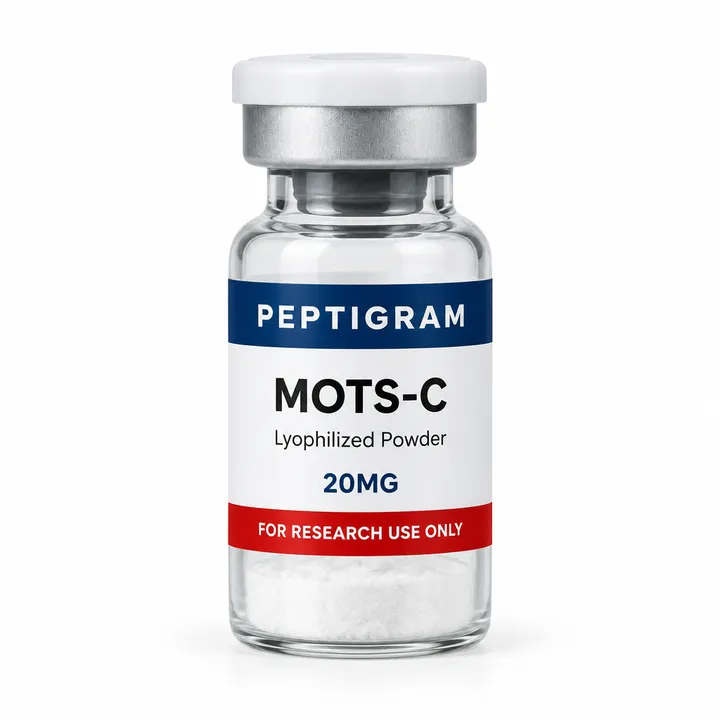
MOTS-c and SS-31 ship as lyophilised (freeze-dried) powder in sealed vials and are dissolved before use, usually with bacteriostatic water. Store them cold and dry. NAD+ is sensitive to light and moisture, so keep the vial closed, dark and cold, and prepare solutions shortly before use.
When you choose a supplier, check for clear research-use labelling, an EU seller and documentation for each batch. For NAD+, a certificate of analysis with batch number is on file; it confirms the identity of the compound by mass spectrometry and reports its HPLC purity. For the other two compounds, documentation per batch is listed on the product page when it is available. You can find the three compounds as MOTS-c 20mg, SS-31 10mg and NAD+ 500mg, and together in the mitochondrial peptides collection.
Frequently asked questions about MOTS-c, SS-31 and NAD+
Why does SS-31 have so many names?
Is MOTS-c related to other mitochondrial-derived peptides?
Why do many NAD+ studies use NMN or NR instead?
How can a laboratory confirm the identity of a batch?
Can MOTS-c and SS-31 be dissolved in the same vial?
Sources
Lee C, Zeng J, Drew BG, et al. (2015). The mitochondrial-derived peptide MOTS-c promotes metabolic homeostasis and reduces obesity and insulin resistance. Cell Metabolism 21(3), 443-454. doi.org/10.1016/j.cmet.2015.02.009
Kim KH, Son JM, Benayoun BA, Lee C (2018). The mitochondrial-encoded peptide MOTS-c translocates to the nucleus to regulate nuclear gene expression in response to metabolic stress. Cell Metabolism 28(3), 516-524. doi.org/10.1016/j.cmet.2018.06.008
Reynolds JC, Lai RW, Woodhead JST, et al. (2021). MOTS-c is an exercise-induced mitochondrial-encoded regulator of age-dependent physical decline and muscle homeostasis. Nature Communications 12, 470. doi.org/10.1038/s41467-020-20790-0
Szeto HH (2014). First-in-class cardiolipin-protective compound as a therapeutic agent to restore mitochondrial bioenergetics. British Journal of Pharmacology 171(8), 2029-2050. doi.org/10.1111/bph.12461
Birk AV, Liu S, Soong Y, et al. (2013). The mitochondrial-targeted compound SS-31 re-energizes ischemic mitochondria by interacting with cardiolipin. Journal of the American Society of Nephrology 24(8), 1250-1261. doi.org/10.1681/ASN.2012121216
Yoshino J, Baur JA, Imai SI (2018). NAD+ intermediates: the biology and therapeutic potential of NMN and NR. Cell Metabolism 27(3), 513-528. doi.org/10.1016/j.cmet.2017.11.002
Covarrubias AJ, Perrone R, Grozio A, Verdin E (2021). NAD+ metabolism and its roles in cellular processes during ageing. Nature Reviews Molecular Cell Biology 22(2), 119-141. doi.org/10.1038/s41580-020-00313-x
This guide summarises published research for information only and reflects the status of October 2026. It is not medical or legal advice. All products on this site are sold for laboratory research use only and are not intended for human or veterinary use.